
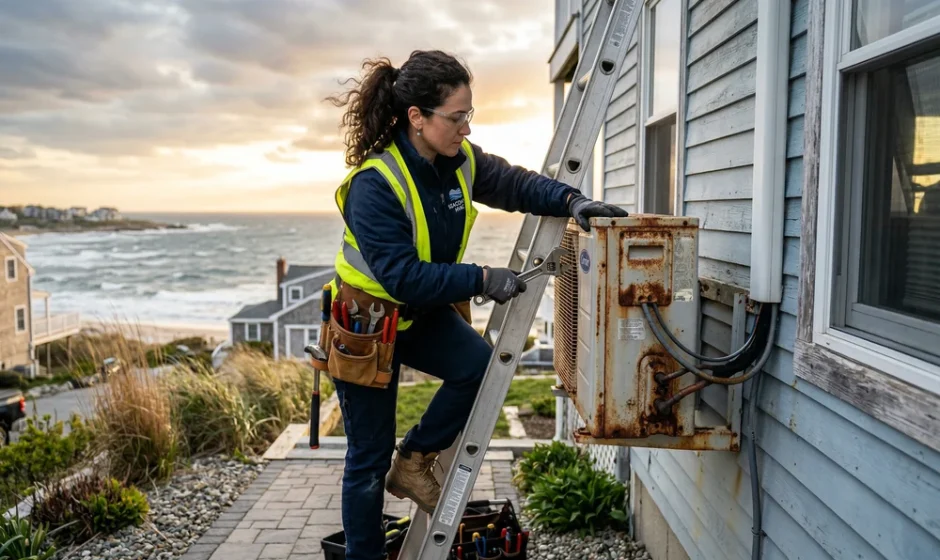

Drive the coast road between Westport and Ocean Shores on a gusty February afternoon and you can taste the ocean a mile inland. That same mist settles on everything left outdoors, including the boxy outdoor unit humming beside thousands of Harbor homes. Heat pumps suit this stretch of Washington better than almost anywhere, since winters rarely bite hard and summers rarely scorch. The catch is that the machine doing all that work lives outside in a fine, constant bath of salt and moisture.
Technicians at Actionaire, working from a Lincoln Street shop in Hoquiam since 1995, see this wear across Grays Harbor every season, and their own advice is to service heat pumps twice a year because salt air and coastal damp age equipment faster than anything inland. That observation is worth unpacking, because most of the harm builds slowly and in spots homeowners almost never look.
The Fins Give Way First
Look at the sides of an outdoor unit and you will see a grille of thin aluminum fins pressed onto copper tubing. This coil is where the heat pump trades heat with outdoor air, and it is also the part salt attacks most eagerly.
Wind carries tiny droplets of seawater that dry on the fins and leave chloride crystals behind. Every rain or foggy morning dissolves those crystals into a weak, conductive film. Where aluminum touches copper, that film sets up galvanic corrosion, and aluminum is the metal that loses. Early on you might notice a chalky white dusting on the fins. Later the fins turn brittle and flake away when brushed, and the coil can no longer move heat the way it was designed to.
Nothing dramatic happens at first. The system simply runs longer to reach the same temperature, your electric bill creeps upward, and backup heat strips switch on more often on chilly nights.
Damp Creeps Into the Control Box
Behind a small access panel sits the electrical heart of the outdoor unit, with a contactor, a run capacitor, wiring terminals and often a defrost control board. These parts were never meant to be wet, yet coastal humidity and wind driven rain find their way in.
Contactor points pit and stick. Capacitor terminals grow green corrosion that raises resistance. Circuit boards develop faint corrosion tracks that cause faults which come and go, so the unit runs fine on Tuesday and refuses to start on Thursday.
Harbor Drizzle Keeps the Defrost Cycle Busy
People assume frost only troubles heat pumps in places with brutal winters. On the coast the opposite can be true. Frost forms most readily on the outdoor coil when temperatures hover a few degrees above freezing and the air is saturated, which describes a large share of Grays Harbor winter days.
When frost builds, the system briefly reverses itself to warm the coil and melt the ice. A cloud of steam rising from the unit during this cycle is normal. What matters is where the meltwater goes. Base pans clogged with leaves, salt crust and spruce needles hold water against the metal, and on the rare cold snap that water can freeze into a solid block around the bottom of the coil.
Rust Shows Up in Plain Sight
A short walk around the unit a few times a year can reveal trouble months before it becomes a repair bill. Signs worth watching include the following.
- Orange streaks running down from cabinet screws or panel seams.
- Fan blades that wobble, or a fan motor that hums, squeals or starts slowly after the unit kicks on.
- Insulation on the refrigerant lines that is cracked, sun bleached or missing near the wall.
- Fins that look white, green or pitted instead of uniform silver.
- A unit sitting in a puddle or sinking unevenly into soft ground.
Fan motor bearings deserve special mention. Salty moisture slips past the seals, dries out the lubricant and leaves the bearing grinding. A seized fan stops airflow across the coil entirely, and the system will shut itself down or overheat soon after.
Placement Buys Years of Service
Where the outdoor unit sits often decides how hard the coast can hit it. Units facing open water or the prevailing southwest storm winds collect far more salt than units tucked on the sheltered side of a house. A fence, shrub line or the house itself can block much of the spray, as long as the barrier leaves enough clearance for air to move freely around the coil.
Height matters too. A stand or pad that lifts the unit above splash zones and pooled water keeps the base pan draining and the electrical components drier.
Coatings and Coastal Ready Equipment
Many manufacturers now offer outdoor units with factory coil coatings, often epoxy or electrocoat finishes, meant for corrosive marine settings. Some build coils entirely from aluminum to remove the copper and aluminum pairing that drives galvanic corrosion. These options usually cost more up front but can add meaningful years for a home within sight of the surf.
Before buying, read the warranty closely. Some equipment warranties include seacoast language that limits coverage for units installed near salt water unless coastal protection was specified.
A Gentle Rinse Between Visits
Homeowners living close to the beach can slow salt buildup with a simple freshwater rinse every month or two, especially after a big windstorm.
- Switch the unit off at the thermostat and at the outdoor disconnect.
- Use a garden hose on a soft shower setting, never a pressure washer, which bends fins flat.
- Spray from the top down so salt washes toward the ground rather than deeper into the coil.
- Keep water away from the electrical access panel.
- Let the unit drip dry for around half an hour before restoring power.
It will not replace professional cleaning, but it keeps salt from building into a crust between visits.
Why the Effort Pays Off
Heat pumps earn their place on the coast. The Northwest Energy Efficiency Alliance started its regional ductless heat pump initiative as a 2008 pilot to show these systems could replace electric resistance heat in existing homes, and Northwest households have leaned on them more each year since. Savings like that only hold up when the outdoor unit stays healthy enough to keep working efficiently.
That is why twice yearly service makes more sense here than the once a year schedule printed in many manuals. A spring visit can clean the coil, check the defrost controls and tighten electrical connections after the wet season. An autumn visit prepares the system for months of steady heating and catches corrosion before the first big storm rolls in off the Pacific.
The ocean air that makes Harbor living so pleasant will never stop drifting inland. A heat pump installed with that air in mind, rinsed now and then and checked by someone who knows coastal equipment, can keep a home warm through many long, gray winters before salt finally wins.